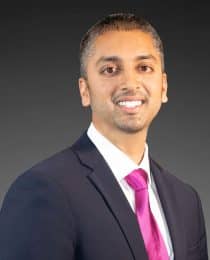
Dr. Ajay Antony is an interventional pain physician who joins The Orthopedic Institute after 4 years as faculty at the University of Florida. He earned his bachelor of science at the University of Florida and earned his medical degree at St. George University School of Medicine. He went on to complete his anesthesiology residency and pain medicine fellowship training at UF. During his residency, he served as Chief Resident, was awarded the Michael E. Mahla Outstanding Resident of the Year Award, Best Resident for Outstanding Dedication and Service to the Department, and Outstanding Resident Teacher Award. After joining the faculty at UF, Dr. Antony served to grow the fellowship program to national recognition, brought several new procedures to the North Central Florida community, and continues to be a recognized leader in his specialty. He also participates in cutting edge research to advance the field of interventional pain medicine.
Dr. Antony is a member of many professional academic societies such as the Alpha Omega Alpha Honor Medical Society, the North American Neuromodulation Society (NANS), and the International Neuromodulation Society (INS). He has lectured both nationally and internationally on neuromodulation, minimally invasive spine procedures, and other topics in pain medicine. Dr. Antony teaches national training courses for fellows and practicing physicians on both spinal cord stimulation (SCS), dorsal root ganglion (DRG) stimulation, and minimally invasive advanced procedures for spinal stenosis. His clinical practice and research focuses on neuromodulation and minimally invasive advanced treatments for pain.
CLINICAL PRACTICE
My clinical practice focuses on evaluating, diagnosing, and treating individuals suffering from chronic pain in an effort to alleviate pain and improve their function. This may include directing a patient to the appropriate conservative measures such as low dose non-opioid medications, physical therapy or lifestyle modifications. It also usually involves combining a procedure to facilitate this goal. Procedures, which are performed under fluoroscopy, can be either diagnostic in order to pinpoint the anatomical structure causing pain, or therapeutic, in hopes of providing durable relief. This also often involves close partnerships with surgeons, to direct patients for surgical evaluation or offer alternatives if surgery is not a good option.
The majority of my practice focuses on spine along with several specialized options for chronic post-surgical pain. Common injection-type procedures include epidural injections, large joint injections, cervical and lumbar radiofrequency ablations, and genicular nerve ablations for knee pain.
At least 30% of my practice has a unique focus on minimally invasive advanced surgical procedures. The field of interventional pain is evolving at an incredibly rapid pace and technology is being used to produce alternatives to largely ineffective traditional options such as opioids. These minimally invasive procedures usually require a specialized training and are done mostly in the ASC, which I will likely be at one day per week. These include 6 big categories of procedures, which are described in more detail below (Spinal Cord Stimulation, Dorsal Root Ganglion Stimulation, Basiovertebral nerve ablation, Minimally Invasive Lumbar Decompression, Sprint Peripheral Nerve Stimulation, and Kyphoplasty). These procedures have generated referrals from the surrounding North Central Florida region either due to the fact that I am the only one offering these procedures, or the fact that I do a high volume of them and have a great deal of experience.
SPECIALIZED PROCEDURES
SPINAL CORD STIMULATION
Spinal Cord Stimulation (SCS) can be thought of similar to "a pacemaker for pain." Epidural leads or wires are placed in the spine and connected to a battery or IPG that delivers very low dose electrical energy. New technology in the past 5 years has allowed more patients to be treated with a higher degree of pain relief. No longer is this thought of as a "last resort" option. The most common indications are chronic pain after back surgery or neck surgery. The best part of this therapy is the fact that there is a trial, or a test run of the device for patients. This involves a simple injection type procedure without incisions, with the battery kept outside the patients' body for a week, so they can experience exactly the type of relief they would have with the device. If they receive significant relief, they come back for a minimally invasive outpatient surgery several weeks after the temporary system is removed in order to implant the device. SCS is a safe, minimally invasive, reversible option for many patients.
DORSAL ROOT GANGLION STIMULATION
Dorsal root ganglion stimulation (DRG) is a specialized form of spinal cord stimulation that has been available in the United States since 2016. It targets a different structure in the spine (the DRG) that allows us to treat pain confined to a focused area, such as the groin, knee, or foot. For chronic post-surgical joint pain, this is the gold standard treatment for severe painful conditions. This procedure requires a specialized training/certification.
BASIOVERTEBRAL NERVE ABLATION
Basivertebral nerve ablation (BVN) is a minimally invasive procedure used to treat chronic low back pain associated with degenerative disc disease. During the procedure, a specialized needle is carefully inserted through the back bones into the affected vertebral body. Once properly positioned, the tip of the needle is heated to ablate (disable) the basivertebral nerves responsible for transmitting pain signals. This procedure can significantly reduce chronic low back pain, particularly pain that worsens with prolonged sitting or forward bending.
MINIMALLY INVASIVE LUMBAR DECOMPRESSION (MILD)
This minimally invasive lumbar decompression procedure is performed through a small incision, approximately the size of a baby aspirin, in the lower back. The incision provides access to a ligament located behind the spinal canal that can thicken and overgrow with age, contributing to spinal stenosis. Once access to the ligament is established, the physician carefully removes small amounts of the thickened tissue to create additional space for the spinal nerves. By relieving pressure on the nerves, this procedure may improve symptoms associated with spinal stenosis, including difficulty standing and walking.
The SPR PNS device is a minimally invasive treatment that uses small needles to precisely access specific nerves believed to be contributing to a patient’s pain. This therapy can be used to treat a variety of pain conditions associated with different diagnoses. The device is designed to remain in place for approximately 60 days, during which time it delivers targeted nerve stimulation to help reduce pain. After the device is removed, patients may continue to experience pain relief for months or potentially years
KYPHOPLASTY
Kyphoplasty is a minimally invasive procedure used to treat compression fractures of the thoracic and lumbar spine. During the procedure, a specialized needle is carefully inserted through the vertebral bone into the fractured area. Once the needle is properly positioned, a small balloon is inflated within the vertebral body to help restore height and correct the deformity caused by the fracture. After the desired vertebral height is restored, the balloon is removed and a medical-grade bone cement is injected into the vertebral body. The cement hardens to stabilize the fractured bone, which can help reduce pain and improve mobility.
SACROILIAC JOINT STABILIZATION
There are several innovative approaches to stabilizing the sacroiliac joint, and we tailor the treatment to each patient’s specific needs and clinical circumstances. We work closely with our spine surgeon colleagues to determine which approach may be best for each individual patient. In some cases, a bone graft from a donor (cadaveric bone) can be placed within the joint to restore the joint space and promote the body’s natural fusion process. In other cases, specialized hardware may be necessary to fixate the joint and facilitate fusion. We take pride in offering the full spectrum for SI joint care in collaboration with our surgeons.
CURRENT RESEARCH OPPORTUNITIES
Dr. Ajay Antony is also the Primary Investigator in several research projects, which may provide eligible patients with opportunities to participate, some of which do not require insurance.
Viadisc- Injecting a processed donor disc material into a degenerative disc with the goal of supporting disc regeneration and improving symptoms
Hydrafil- An FDA monitored investigational treatment involving the injection of a polymer-based material into a degenerative disc with the goal of supporting disc repair and regeneration.
Spinal cord stimulation for asthma- An FDA monitored investigational approach involving the implantation of spinal cord stimulation devices with the goal of reducing asthma symptoms and improving symptom management.
Posterior SI Joint Allograft- A procedure involving the placement of donor (cadaveric) bone material into the sacroiliac (SI) joint to encourage the body’s natural bone growth and promote fusion of the joint.
Posterior oblique SI Joint Fixation - A minimally invasive way to place specialized hardware into the SI joint to stabilize the joint and facilitate a fusion. This procedure allows a quicker recovery and less tissue disruption compared to the normal hardware placement.